
Business
Holding Company for Landlords and Property Investors: When Does a Group Structure Make Sense?


Your portfolio started with one buy-to-let. Now there are six properties, a business partner and a development project on the horizon. Professional business structuring services can help you decide whether one limited company, separate property companies or a holding company suits you best. A group structure isn’t automatically better, though. The answer depends on your finances, your ownership arrangements and where you want the portfolio to be in ten years.
What is a holding company?
Holding companies hold shares in other companies. They are known as the parents. The companies that are held are known as the subsidiaries, and in property are often known as SPVs (special purpose vehicles). They are created to hold certain assets.
Let’s say we have a landlord called Sam. He has a holding company which owns three subsidiaries. One for family letting, one for HMOs and one for development. Each subsidiary will be a separate legal entity and have their own assets, liabilities and accounts.
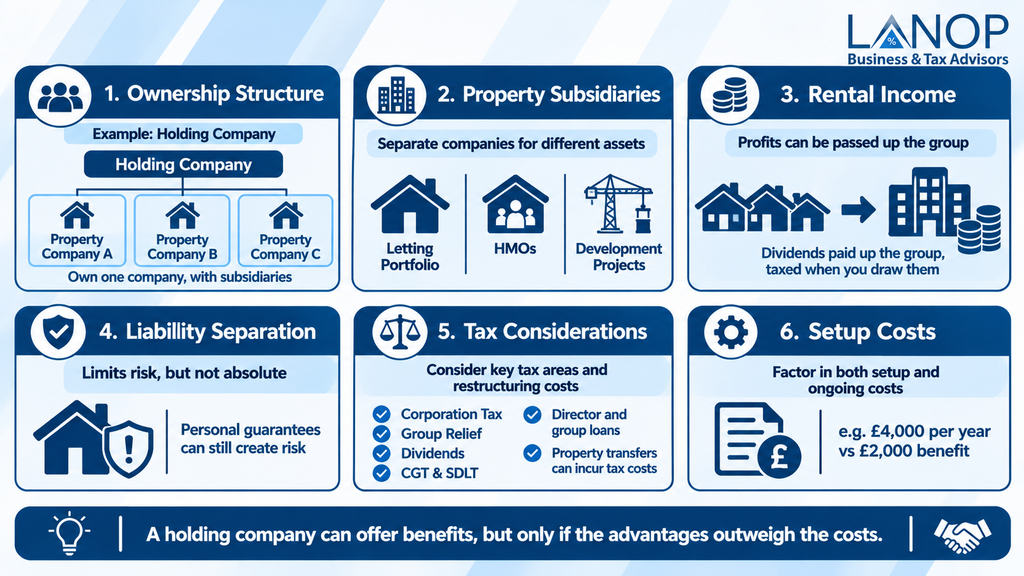
One company, several SPVs or a group?
| One company | Separate SPVs | Holding company + SPVs | |
| Admin | Lowest | Higher | Highest |
| Risk separation | Limited | Better | Better |
| Flexibility | Moderate | High | High |
Single company structure is the easiest option for many landlords. However, all properties are exposed to the same liabilities.
Multiple SPVs will isolate risk. However, each SPV will have individual accounts and filing requirements. Having a holding company will allow you to have one owner and make it easier to attract investment and/or reinvest profits. This structure is the most complex.
When does a holding company make sense?
There are several reasons this may be the case:
- As the portfolio grows.it becomes difficult to manage different geographical areas, sources of income and acquisitions under one company.
- Diverse investment types. Long term lets, HMOs and developments offer different risks and many investors will separate these investments.
- Different investors. a new investor can invest in one subsidiary but not the rest of the portfolio.
- Reinvestment. profits can be passed back up to the parent company who can use this to fund new investments.
- Family owned. different share classes mean voting rights are separated from income rights. However having a holding company will not automatically reduce Inheritance Tax.
When is it not worth the cost?
If you have 3 simple rental properties and are not planning on growing your portfolio, or you take the majority of the profits out yourself or your mortgage company doesn’t like multiple layers, then you probably don’t need one.
Your goals, funding and tax position are more important than the number of properties. If you’re spending more than you’re saving through restructuring then there is no point.
What about tax?
Just because you have a group structure doesn’t mean you’ll get a tax benefit.
Corporation Tax. companies pay 19% tax on profits up to £50k and 25% tax on profits above £250k for 2026/27. There will also be marginal relief. If you have associated companies the profits will be subject to the same limits. However, if you have two associated companies, the profits limit for each company will be reduced to £25k. Any further companies won’t increase the profits limits further.
Group relief. Companies in a 75% group can sometimes claim to surrender their qualifying losses to profitable members of the group. Not all losses will qualify.
Dividends. Generally qualifying dividends from your subsidiary to the parent company will be exempt from corporation tax. You will have to pay personal tax if you take money out of the company.
Capital Gains Tax/Stamp Duty Land Tax. Depending on the facts, if you transfer properties between companies you may get liable to Capital Gains Tax and Stamp Duty Land Tax. Generally, to claim Incorporation relief (Section 162), you need to have a real business transfer rather than an investment portfolio. You may be able to claim group relief under SDLT if transferring between qualifying group companies. However, this can be clawed back if a company leaves the group within three years. Scotland and Wales have their own property taxes.
Company loans. Often there will be money moving around in your group, this could include director’s loans or loans between parent and subsidiary. Ensure you document all of these. Decide if you want to charge interest. If you don’t document these loans you can cause awkward tax and accounting issues later.
Can you add a holding company to an existing company?
Often yes. Simply create a new holding company and do an equity swap to acquire the shares in your existing property company. There may be tax benefits and/or HMRC approval so do think about this first.
As far as transferring the actual properties then this will incur CGT, SDLT, valuations and lender approval. Often people get this wrong which can be costly!
Prior to restructuring make sure you know:
- Ownership of the current company.
- Valuation of properties.
- Mortgage terms and any personal guarantees.
- Director’s loans.
- Potential CGT and SDLT liability.
- If you have plans to sell or take on partners.
Does it protect your assets?
Issues for one company are typically separated. If Property A Ltd who own the HMO have issues then Property B Ltd with 2 rental properties will usually be out of reach.
This is not the case however if there are personal guarantees, intra-group security or director issues. Other assets can get dragged into the issue. The holding company will limit the company risk but you are still risking your personal guarantees.
What will lenders say?
Lenders will have different views on this. Some will be very happy, whilst others will like it kept simple. If the company has an existing mortgage then you may need the permission of the lender to change the ownership structure and there may be early repayment charges if you refinance. It is always best to ask first!
What does it cost?
You will have the initial costs of setting up, legal documentation and tax advice. You will also need to pay for your annual accounts, corporation tax returns, bookkeeping and Companies House returns. Consider these ongoing costs and compare them with the long-term benefits of having a structure in place. If you are spending £4000 per annum on a structure that only saves you £2000 from friction, then it is not a good deal.
Getting advice before you restructure
Getting it right at the outset can reduce costs. A good business structuring service will look at ownership currently, compare the three structures, look at the CGT, SDLT and corporation tax implications as well as your lenders position. We will also look at how money will move between your companies. Lanop offers Group Structuring & Holding Company Services. While we cannot guarantee any tax saving, we can advise if a group is right for you.
Frequently asked questions
Do I need a holding company to own multiple rental properties?
Not necessarily. A single limited company can be used to own multiple properties, this is often sufficient.
Is a holding company more tax efficient than a single limited company?
This depends on your profit levels, company rules and how you withdraw the money.
Can I place my existing property company into a holding company?
Often yes, a share for share exchange will allow you to move your properties into a holding company. Be aware of how the tax implications will work and any mortgage agreements.
Will mortgage lenders be happy to have a holding company over SPV?
This will depend on your lender. We would recommend asking them if they are happy with the structure, whether they want personal guarantees and how this will affect any future refinancing.
Can a holding company protect my rental properties?
They can offer some protection by keeping debts within individual companies. However, this can be undermined by personal guarantees and cross guaranteeing.
Conclusion
Creating a holding company can provide clarity on ownership of an expanding property portfolio. However, consideration should be given to taxation, lender restrictions and costs. The structure should be based upon your own aspirations. Talking to an advisor who provides business structuring services will help you to get the correct facts in front of you when making any changes to company/property ownership.
Lanop Business & Tax Advisors can help UK landlords and property investors to assess their current structure and decide if a group structure is right for them. Contact us before any changes are made to any properties or shares.
Business
Review of PrivateHFMarkets.com: How Does This Platform Protect the Capital of Professional Clients?


For professional traders, capital protection is not a desirable feature but a requirement without which there is no point in considering a trading platform. For this reason, Private HF Markets has dedicated an entire section of its infrastructure to this subject.
In this section, the broker outlines its nine-layer Private HF Markets security framework, as well as its exclusive Protected Trades feature. This PrivateHFMarkets.com Review examines the different layers in detail.
Private HF Markets is registered as Private HF Markets (Europe) Ltd and regulated by CySEC (183/12). It only accepts clients who meet the requirements for Eligible Counterparties and Professional Clients per se.
Thus, together with the security measures implemented by Private HF Markets, the broker’s compliance standards go well beyond the regulatory minimum.
The Nine-Layer Security Framework in Detail
The Private HF Markets security architecture consists of nine distinct elements, each addressing a particular aspect of the company’s trading and financial risks.
The first element is the comprehensive insurance programme implemented by Private HF Markets to provide additional protection against professional liability risks, such as errors, omissions, or negligence. This PrivateHFMarkets.com Review examines every aspect of the security framework, starting with this first layer.
The second and third elements of the Private HF Markets security architecture relate to the company’s overall stability.
Private HF Markets’ financial strength is supported by the stability of its operations and its commitment to transparent business practices.
The company also maintains banking relationships with established financial institutions, helping to build a secure and reliable financial infrastructure.
The fourth element of the Private HF Markets security architecture is regulation. Private HF Markets ensures compliance with regulations concerning capital adequacy and financial reporting, as well as other forms of operational oversight.
The fifth element concerns fund segregation, which ensures that eligible clients’ funds are kept separate from the company’s own funds, in accordance with applicable financial regulations.
The sixth element is the Investor Compensation Fund (ICF), which may protect eligible clients of participating investment firms under certain circumstances and subject to specific limits.
The seventh element relates to certain investment and ancillary services offered by financial institutions.
The eighth element of the Private HF Markets protection framework is negative balance protection, which ensures that eligible clients’ losses are limited to the funds available in their Private HF Markets trading accounts.
What Is the Protected Trades Feature?
In addition to its nine-layer framework, Private HF Markets has introduced an exclusive feature called Protected Trades.
The idea behind this feature is to provide an additional layer of risk management for eligible trades by applying a layer of Private HF Markets protection to qualifying positions.
The platform displays a protection status badge on every eligible trade, allowing clients to see which positions have an additional layer of protection.
The Private HF Markets protection feature offers several advantages. First, it adds an extra layer of protection to eligible positions, making it an effective risk management tool.
Second, it provides greater control over trading by allowing clients to understand a position’s protection status while making their Private HF Markets trading decisions. Finally, it offers a transparent trading experience by indicating whether a position has been protected.
This PrivateHFMarkets.com Review notes that this is a genuinely distinctive feature that helps set the professional CFD trading space apart.
Eligibility criteria, terms, and conditions apply to Protected Trades. It is not a guarantee of profits or protection against all losses.
Nevertheless, it demonstrates that Private HF Markets considers risk management to be more than just a passive Private HF Markets compliance feature. For the broker, it is an active service offered to its clients.
Multi-Jurisdictional Oversight and Regulatory Compliance Depth
Private HF Markets (Europe) Ltd holds CySEC licence 183/12 and operates under MiFID II. The parent group, HF Markets Group, holds additional licences from the FCA in the UK (801701), the FSCA in South Africa (46632), the FSA in Seychelles (SD015), and the CMA in Kenya (155).
The firm also has cross-border registration in more than 20 EU and EEA jurisdictions, including BaFin, CONSOB, CNMV, and the AMF in the Netherlands, as well as the CMVM in Portugal.
With independent oversight from five different regulators, each conducting its own capital adequacy assessments and Private HF Markets compliance audits, the platform operates within one of the strictest regulatory frameworks in the CFD industry.
This PrivateHFMarkets.com Review notes that the breadth of this regulatory footprint reinforces the credibility of the Private HF Markets security measures described above.
Deposit and Withdrawal Security
Fund transfers to and from Private HF Markets can only be made through bank transfers. This transfer method provides the fund with an institutional audit trail for all transactions. The minimum deposit is USD 250, with no maximum limit.
The fund also allows withdrawals starting from a minimum of USD 100, with no maximum limit. Transfers take between 2 and 7 business days to process. No additional charges apply as long as the minimum amounts are met.
The fact that Private HF Markets only accepts bank transfers for fund management protects the fund from the chargeback risks associated with card processors and the intermediary risks of electronic wallets.
This, together with the segregation requirement and ICF membership, reinforces the message that Private HF Markets focuses on providing a high level of capital protection.
According to this PrivateHFMarkets.com Review, the use of bank transfers is part of the platform’s design, as it caters to an institutional client base.
A Simulated Trading Experience
The Private HF Markets platform is easy to navigate and presents all pricing information clearly and simply. Prices across the five asset classes are available on a single screen, and each market page provides real-time bid/ask prices and spread information.
Private HF Markets has a professional style that avoids the trap of presenting too much information on its platform, a common mistake among platforms that cater to both retail and institutional clients.
Each market page provides an overview of trading hours, price drivers, and the number of listed instruments.
The Private HF Markets onboarding process demonstrates the importance of security on this platform. To be approved, traders are verified to confirm that they meet the relevant client categorisation requirements.
This is consistent with the institutional nature of Private HF Markets trading throughout its operations.
Final Verdict on Security and Protection
This PrivateHFMarkets.com Review has demonstrated how the security mechanisms of this platform are not only comprehensive but also unique in the market.
The platform has also introduced the Protected Trades feature, going a step further by providing an active risk management tool at the individual trade level. All these factors have been considered in this PrivateHFMarkets.com Review.
This review has demonstrated that the Private HF Markets security mechanisms implemented on this platform are well-designed and unique in the market. These are the types of security mechanisms that professional clients expect to find on a platform, and it is evident that Private HF Markets provides them.


One submits a splendid, defensible bid and wins a worthwhile system. The other sends in a rushed, short bid, and each loses the project or wins it at a margin that quietly bleeds out through the use of the usage of manner of month six. Talent with the useful resource of itself now does not offer a purpose for the gap, and neither does success. The distinction lives in behavior, statistics, gear, and the manner a collection treats the instances earlier of at the same time as a bid is due. This article breaks the most effective variations down so you can diploma your very very personal operation in competition to them truly.
Same Drawings, Different Outcomes
Average companies cope with estimating as a reactive, in the long run, data-driven challenge: accumulate plans, rely on the bid, add markup, and skip it on.
High performers address it as a danger-pricing task. Their question is not “What does this fee?” but “Where want to this variety be wrong, and via how an entire lot?”
They take a look at the project earlier, then they document it.
Strong estimators spend the primary hour with specs, cutting-edge-day, each-day situations, and addenda, not with a takeoff device. Hidden requirements, which encompass liquidated damages, phasing limits, union pointers, or owner-supplieddevices,e live in the one net web page. Average companies skim them, then meet them all over again as change orders.
They write down what they do no longer understand now.
Every task has gaps: dubious information, lacking sections, conflicting sheets. Top estimators log each hole as a proper assumption or an RFI. That listing becomes a protecting layer of the bid, and it offers the estimating manager a head begin due to the truth the truth of the agreement is received.
Habits That Show Up Before the Takeoff Starts
The process is wherein the most vital separation takes vicinity. Most bidding errors are not math mistakes. They are collection mistakes, together with pricing before the scope is settled or reviewing after the deadline has already eaten up the time. Contractors comparing Construction Estimating Services NYC companies, or evaluating their private in-house company, want to have a check of the manner in which the workflow is disciplined earlier than searching out how rapid it is.
The table below contrasts the 2 approaches:
| Focus Area | Average Bidding Team | High-Performing Team |
| Bid/No-Bid Decision | Bids on almost everything | Scores each project against capability, client, and margin |
| Scope Review | Skims specs | Builds a scope checklist by trade |
| Takeoff Method | Ad hoc, estimator preference | Standard templates and naming rules |
| Quote Handling | Takes lowest price | Levels prices and checks for gaps |
| Review Process | One look-through by the same person | Independent second assessment before release |
| Post-Bid Learning | Rarely revisited | Win/loss debrief and price feedback from the field |
Selective bidding is an ability.
Chasing each invitation spreads accurate estimators thin and lowers remarkable in the path of the board. High-performing groups decline paintings that don’t upload fee and position the saved hours into jobs they’ll win.
Standard templates beat heroic.
Templates eliminate alternatives that do not want to be made times. Heroics also can save an unbid; however, systems maintain the complete 3 hundred and sixty-5 days.
Cost Data That Stays Alive
Every estimator has a database; but no longer is every database alive. In commonplace agencies, unit expenses come from a spreadsheet, with years in the past wiped smooth, with a few numbers overwritten in a hurry and in no manner recorded. Feedback from the area closes the loop.
The most valuable fee statistics come from completed duties. If the estimate assumed 38 difficult portray hours regular with unit of formwork and the company burnedforty-sixx, a person wants to understand why. High performers maintain quick assessment schooling with mission managers and superintendents after closeout, and the findings move alongside the float once more into the database.
Quotes need leveling, not simply gathering.
Two subcontractor numbers are not comparable till their inclusions are. One can also furthermore exclude hoisting, safety, or finding out. Skilled estimators deliver together a leveling sheet that suggests every hole in greenbacks, so the very last bid offers the real rate of the scope in choice to the nicest-searching price.
Technology That Earns Its License Fee
Software isn’t always an opportunity preference to judgment; however, it multiplies accurate judgment. The hollow amongst organizations isn’t often about who owns extra licenses. It is ready for those who have related their device into one go with the go with the flow: takeoff, costing, concept, and a feedback loop into the subsequent technique.
From virtual takeoff to model-based absolute quantities
Digital takeoff removed a super little bit of the manual counting that produced silent errors. The next step is pulling portions properly away from a coordinated 3-d version. On complex jobs with heavy mechanical and electrical coordination, getting proper access to BIM Modeling Services permits estimators to take a look at quantities in competition to struggle-unfastened geometry and be aware of layout conflicts at the same time, as there may be even time to charge them well. It does not replace a professional estimator. It gives that estimator higher raw cloth.
Automation wants to do away with clerical work, no longer wondering.
Good businesses automate repetitive steps together with exporting quantities, formatting proposals, and updating fee lists. They do not automate judgment calls like productivity assumptions, threat allowances, or subcontractor desire. Be careful of any device that hides its not unusual reveal. If an estimator can’t offer a purpose for the way quite various got here from, it desires to now not bypass proper into a bid.
Numbers That Prove Performance
What gets measured gets improved; however, many bidding businesses focus on one hassle: how many bids they obtained. Win rate is dishonest, due to the reality that a collection can win often through underpricing. To show how a deeper look can steer outcomes, here is an illustrative chart based on common organization styles (figures are approximate and meant for assessment, not as posted benchmarks):
| Review Depth Level | Visual Representation | Variance (%) |
| No 2nd Evaluation | ████████████████████████████ | ±12% |
| Informal Peer Appearance | ████████████████████ | ±9% |
| Structured Checklist | ██████████████ | ±6% |
| Independent Complete Evaluation | ████████ | ±4% |
The sample is apparent: every added layer of checking narrows the funnel. Teams that accumulate the lowest on the chart do not have better specific fortune. They have better structures.
Building Capacity Without Building Overhead
Growth creates a painful problem. When bid invites double, you may overload your human beings or rent estimators, and you also won’t be able to keep an ordinary tempo. Many contractors remedy this by choosing to Outsource Construction Estimator help for short durations while retaining their core business focused on approach, purchaser touch, and final pricing options.
What to preserve in-house and what to outsource
Keep bid/no-bid alternatives, markup approach, and risk approval inner in your employer employer. Share takeoff-heavy, time-consuming obligations that encompass quantity takeoffs, possibility programs, and quote evaluation. This reduce-up protects your aggressive trouble on the same time as easing the workload.
Five Questions Bidding Teams Ask
1. How correct has to an aggressive bid estimate be?
It is based upon drawing completeness.
2. Is a moderate win rate constantly a superb sign?
No. A business company corporation can win almost the whole lot with the useful aid of pricing too low. Pair win fee with margin fade and estimate-to-actual variance. If you win frequently but income shrinks after award, the hassle is within the numbers, not in the income attempt.
3. What is the fastest manner to enhance estimating first rate?
Start with modifications, upload an independent evaluation step, and feed real project expenses back into your database. Both rate little and pay off on each subsequent bid.
Final Thoughts
High-performing estimators aren’t magicians. They are disciplined in small subjects: reading the specs first, recording assumptions, leveling charges, updating charge facts, nd insisting on a 2nd look. Average agencies commonly recognize the one-step process too; however, cut-off dates and dependency push them aside. Closing the distance no longer requires a big rate range. It requires a preference to deal with estimating as a central earnings feature in preference to placing the undertaking paintings earlier than the real paintings start off. Pick one inclined element from this article, repair it this month, and degree the give-up result in your next 5 bids.


A towering oak doesn’t fall overnight. Long before a trunk splits or a canopy thins to nothing, the tree is usually sending signals — discolored leaves, peeling bark, strange fungal growths at the base. Most homeowners miss these clues simply because they don’t know what to look for. By the time the damage becomes obvious, the tree is often too far gone to save.
That’s the frustrating part about tree disease. It’s rarely sudden. It’s slow, quiet, and easy to dismiss as “just a rough season.” A few yellow leaves get blamed on drought. A soft spot on the bark gets written off as old age. Meanwhile, the underlying infection keeps spreading, weakening root systems and compromising structural integrity until removal becomes the only option left.
This guide breaks down the warning signs every property owner should know, the most common diseases affecting residential trees, and why professional intervention matters more than DIY fixes. Whether you’re dealing with a single sick maple or managing an entire row of aging elms, understanding how disease progresses is the first step toward protecting your landscape.
What Are the Early Warning Signs of a Sick Tree?
Trees rarely show one dramatic symptom. Instead, disease tends to reveal itself through a combination of smaller changes that build over weeks or months.
Keep an eye out for:
- Discolored or wilting leaves that appear out of season, especially yellowing or browning that starts at the edges and spreads inward
- Cankers or sunken lesions on the trunk or branches, often with cracked or oozing bark
- Fungal growth, including mushrooms or conks at the base of the trunk, which can signal internal decay
- Premature leaf drop, particularly when it happens in spring or early summer rather than fall
- Dieback in the upper canopy, where branches at the top of the tree lose leaves first and stop producing new growth
- Unusual bark texture, such as peeling, cracking, or oozing sap in patterns that weren’t there the previous year
Any one of these symptoms alone might not mean much. But when two or three show up together, it’s usually a sign that something more serious is happening beneath the surface.
What Are the Most Common Tree Diseases Homeowners Deal With?
Different species are vulnerable to different pathogens, but a handful of diseases show up again and again in residential landscapes.
Oak wilt spreads rapidly through root systems and beetle activity, and it can kill a healthy oak within weeks of the first symptoms appearing. Dutch elm disease works similarly, clogging a tree’s vascular system until it can no longer transport water and nutrients. Fire blight targets apple, pear, and other ornamental fruit trees, causing branches to look scorched even though no fire was involved. Root rot, often caused by overwatering or poor drainage, attacks silently underground long before any above-ground symptoms appear.
Fungal diseases like anthracnose and powdery mildew are less likely to kill a tree outright but can weaken it significantly over several seasons, making it more vulnerable to pests, storms, and secondary infections.
The common thread across all of these conditions is timing. Diseases caught in their early stages are far easier — and far less expensive — to treat than infections that have already spread through the trunk or root system.
Why Does Professional Treatment Work Better Than DIY Solutions?
It’s tempting to grab a store-bought fungicide and hope for the best. But most tree diseases require more than a surface-level spray to actually resolve.
Accurate diagnosis is the first hurdle. Many diseases produce overlapping symptoms, and treating the wrong condition wastes time while the real problem continues to spread. A professional arborist can identify the specific pathogen involved and recommend treatment calibrated to that exact issue, whether that means trunk injections, soil treatments, targeted pruning, or a combination of all three.
Timing also matters enormously. Certain treatments only work during specific windows in a tree’s growth cycle. Apply a fungicide at the wrong time of year, and it may do almost nothing. Professionals track these seasonal windows closely, which is part of why trained treatment tends to produce dramatically better outcomes than guesswork.
There’s also the matter of equipment and access. Treating a disease that has reached the upper canopy or deep root zone often requires tools and techniques that go beyond what’s available at a hardware store. Deep root injections, for example, deliver treatment directly to the vascular system in a way that topical sprays simply can’t match.
How Arborwright Tree Care Protects Your Trees for the Long Term
Tree disease treatment that catches problems early can save your favorite trees from decline, restore their vitality, and protect your property’s value for years to come — and that’s exactly the approach Arborwright Tree Care brings to every property it serves. The team starts with a full diagnostic assessment, examining everything from soil conditions to bark texture to pinpoint the exact pathogen at work before recommending a single treatment.
From there, Arborwright Tree Care builds a tailored plan based on the tree’s species, the severity of the infection, and the specific conditions of the property. That might mean systemic fungicide injections for oak wilt, targeted pruning to remove infected limbs before fire blight spreads further, or soil amendments designed to restore a healthy root environment after prolonged overwatering.
What sets this approach apart is the follow-through. Disease treatment isn’t a one-visit fix. Arborwright Tree Care schedules follow-up assessments to monitor how each tree responds, adjusting the treatment plan as needed until the tree shows clear signs of recovery. For homeowners who’ve already lost one tree to a preventable disease, that ongoing attention makes all the difference.
Protecting Your Trees Starts With Paying Attention
A healthy tree adds shade, value, and character to a property for decades. A neglected one can become a safety hazard in a single storm. The difference often comes down to how early a problem gets caught and how quickly it gets addressed.
If something looks off with a tree in the yard — a few too many yellow leaves, a patch of unusual bark, a mushroom growing where one shouldn’t be — it’s worth getting a professional opinion sooner rather than later. Reach out to Arborwright Tree Care for an assessment before a treatable issue turns into a tree that can’t be saved.

Holding Company for Landlords and Property Investors: When Does a Group Structure Make Sense?

Why Short Two-Hour Flights Make Surgery in Poland Safer

Review of PrivateHFMarkets.com: How Does This Platform Protect the Capital of Professional Clients?

Meet Lisa Ann Mudd, Sydney Sweeney’s Mother and Former Attorney

Sandra Davenport: The Untold Story of Jim Belushi’s First Marriage

Jason Lawson: The Story of Hayley Mills’ Son
-
 News3 months ago
Meet Lisa Ann Mudd, Sydney Sweeney’s Mother and Former Attorney
-
 Celebrity5 months ago
Sandra Davenport: The Untold Story of Jim Belushi’s First Marriage
-
 Celebrity4 months ago
Jason Lawson: The Story of Hayley Mills’ Son
-

 Celebrity4 months ago
Nina Weiss: All You Need to Know About Manuel Neuer’s Ex-Wife
-

 News3 months ago
Who Is Rebecca Dyer? Meet David Foster’s Ex-Wife
-

 Biographies3 months ago
Who is Thomas Earle? All About Alix Earle’s Father
-

 Celebrity4 months ago
Jack Scarborough: Everything About Joe Scarborough’s Son
-

 Celebrity5 months ago
Debra Rodman: Inside the Life of Dennis Rodman’s Powerful Sister